Menu
To Catch a Convict: a tutorial
To Catch a Convict
This user guide will walk you through the steps of tracking down a convict by looking at online resources only. This guide will also demonstrate how to narrow down your search using each database, and therefore will be of use for your non-convict research as well.
James Bent
Bent's name was included on the Chronological Register of Convicts at Moreton Bay, 1824-1839, held by the Queensland State Archives. This, and similar lists, are useful if you are identifying convicts who were assigned to a particular area (e.g. Limestone Station), not so useful a starting point if you are trying to track down your ancestor. For our purposes, however, it gives us a name to start with.
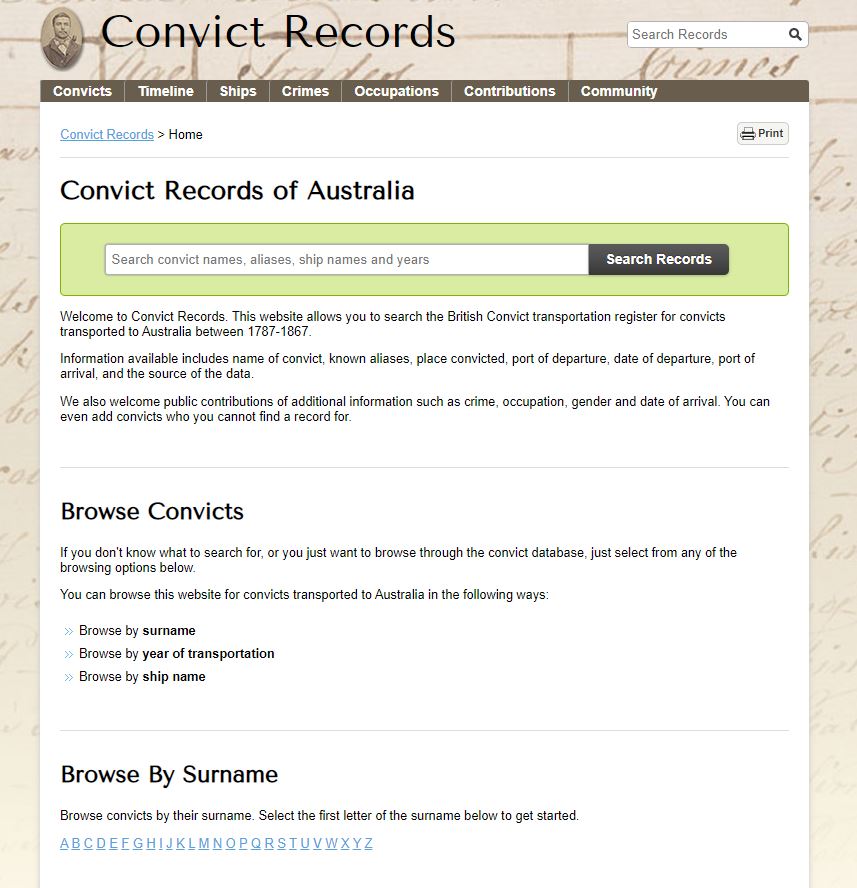
Convict Records of Australia
Convict Records of Australia enables searching of the British convict transportation register, between the dates 1787 and 1867. It is a great starting point if you already know the name of the convict you are searching for. However, as a lot of the information has been provided by other researchers, you will still want to verify this information, if possible by sighting digital copies of the original documents (as we will demonstrate throughout the course of this tutorial).
Searching the database is easy. Simply type the name of the convict (it will search aliases too), ship, or year of transportation into the search bar and select 'search records'.
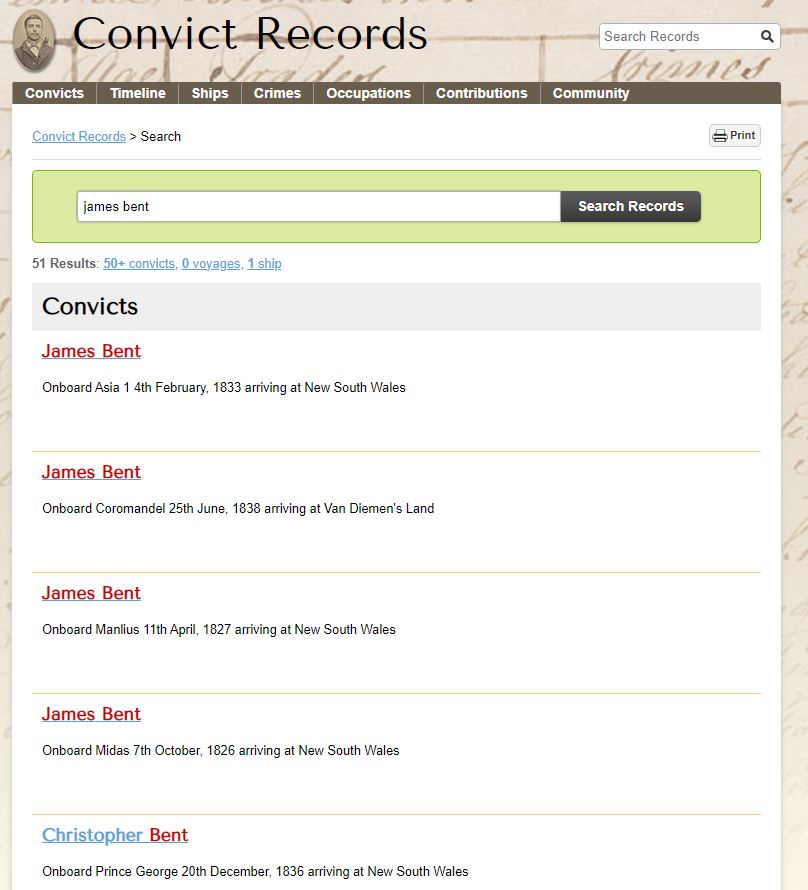
We have 4 hits for James Bent. At this point, you may need to open the results for each James Bent. This might result in following some false leads until we determine which of these four men is our James Bent.
Because we have found our James Bent using with the Chronological Register of Convicts at Moreton Bay, 1824-1839, we know from this record that Bent arrived on the vessel Midas, therefore the fourth Bent on this list, which makes reference to the Midas, has to be our convict.
| A side note on the usefulness of the ship name: if more than one convict has the same name, the easiest way to confirm you are following your convict's paper trail is to check the name of the ship. In most records, this detail is included alongside the convict's name. |
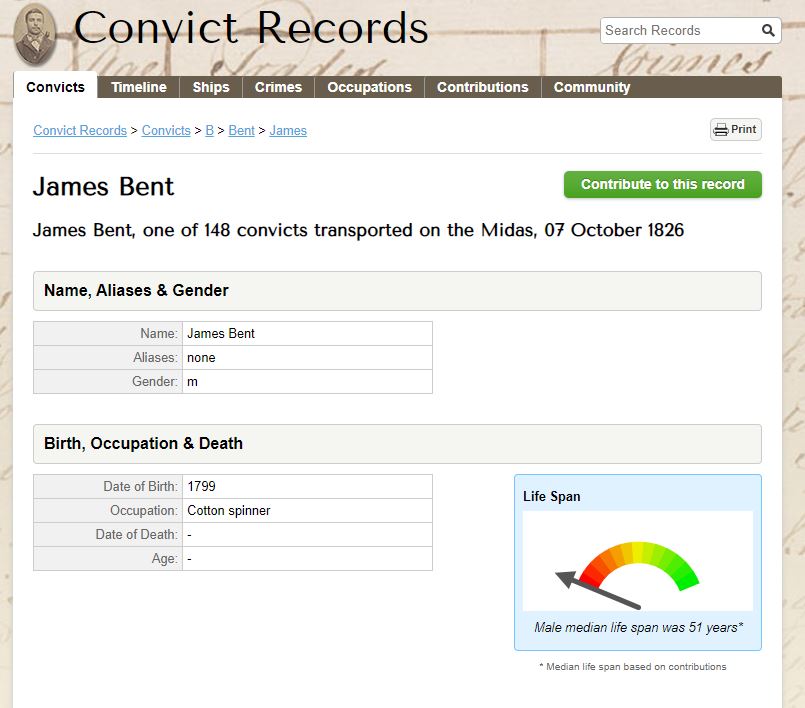
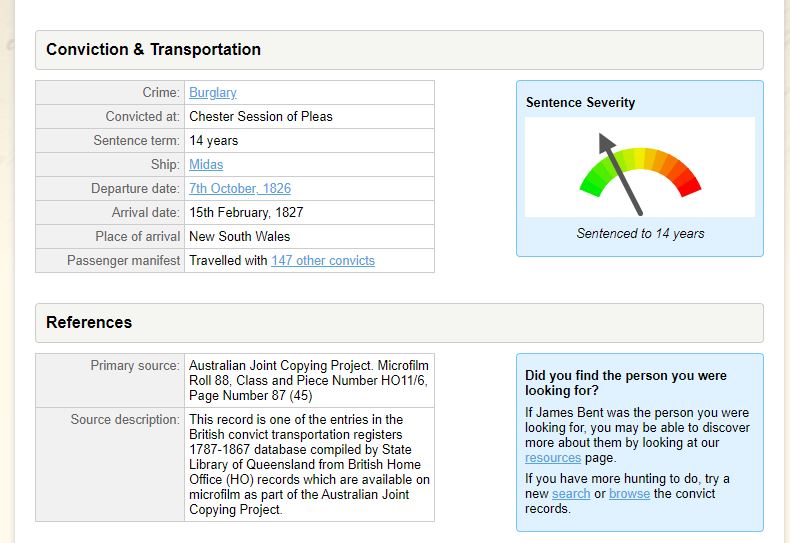
From the records here, we learn that James Bent was born in 1799 and worked as a cotton spinner. He was convicted of burglary at the Chester Session of Pleas and sentenced to 14 years transportation to New South Wales. He departed England on the 7th October 1826 and arrived in New South Wales on 15th February 1827, traveling with 147 other convicts on the Midas.
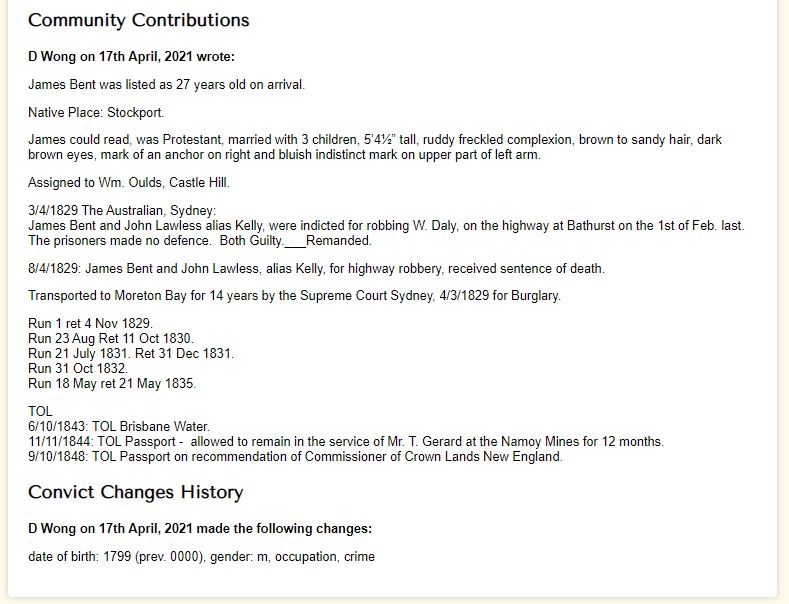
Community contributions to this site fill in more of Jame's story. He was 27 when he arrived in New South Wales, from his home at Stockport. We also learn that James had a level of education, as he could read, and he was raised a Protestant. He was married with 3 children (did he ever see them again? We will have to follow their story too).
He is described as being 5'4½" tall, with a ruddy freckled complexion, brown sandy hair and dark brown eyes. Tattoos were common amongst convicts, and it appears that James had an anchor on his right arm and an indistinct bluish mark on the upper part of his left arm (does the anchor denote a connection to the sea? We will have to see).
We assume that on arrival to the Colony he was assigned to William Oulds at Castle Hill (again, something that needs confirming as we check through other records).
Looks like there may have been a second conviction. James, along with John Lawless (aka Kelly), were indicted for robbery on the highway at Bathurst, after they robbed W. Daly on the 1st February 1829. Both men made no defence, were found guilty and sentenced to death. Thankfully for our story, Bent was instead transported to Moreton Bay by the Supreme Court in Sydney, for 14 years.
This information is a great starting point, but we do need to confirm it by sighting the documents ourselves, and finding out what else we can uncover.
Ancestry Library Edition
| Ancestry Library Edition is free to access on any computer at Ipswich Libraries. You will need to book a computer at one of the Library branches. Please note, computer sessions last for one hour. If you use the computer in the Ipswich History Room, you do not have to book, but will still have to login for access. |
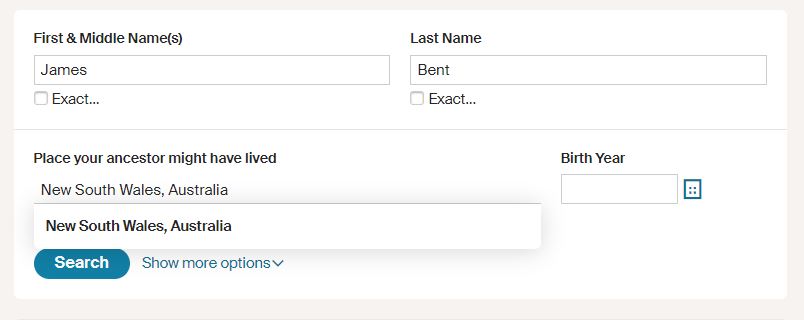
On the search page, enter the known details of your convict and click search.
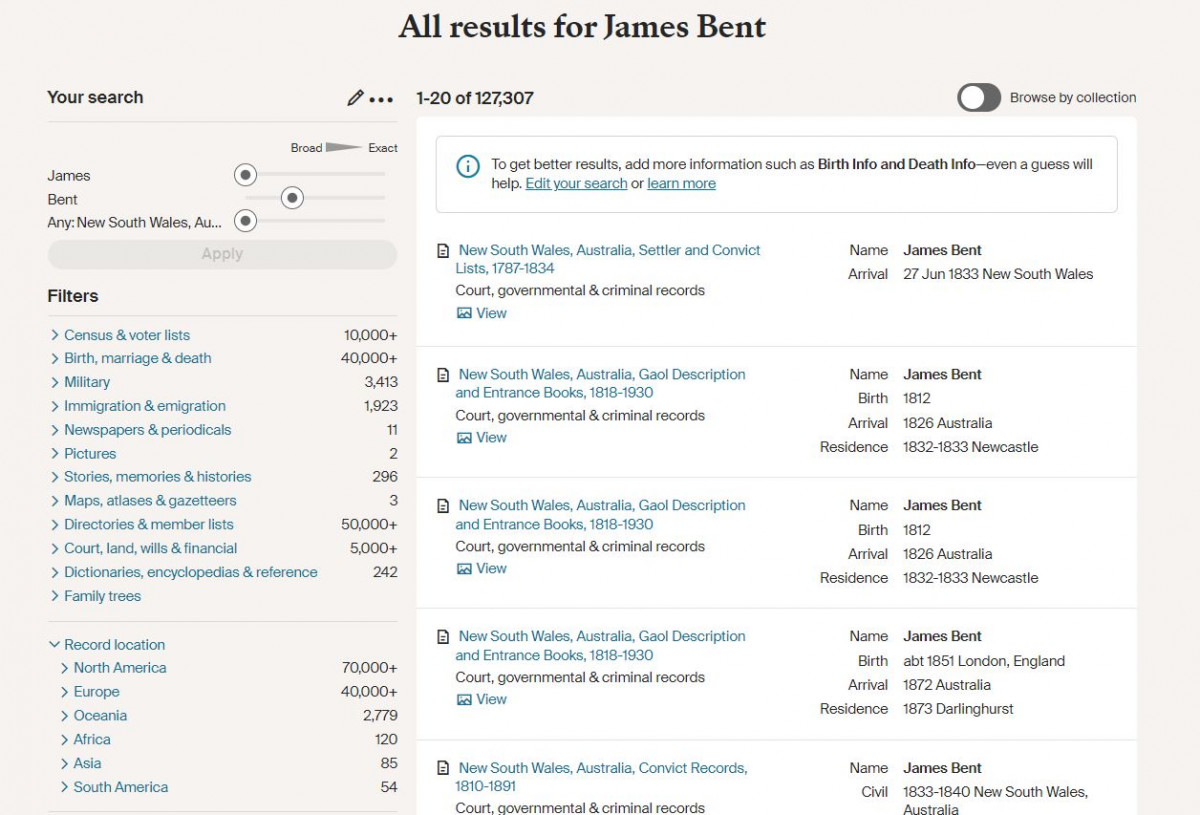
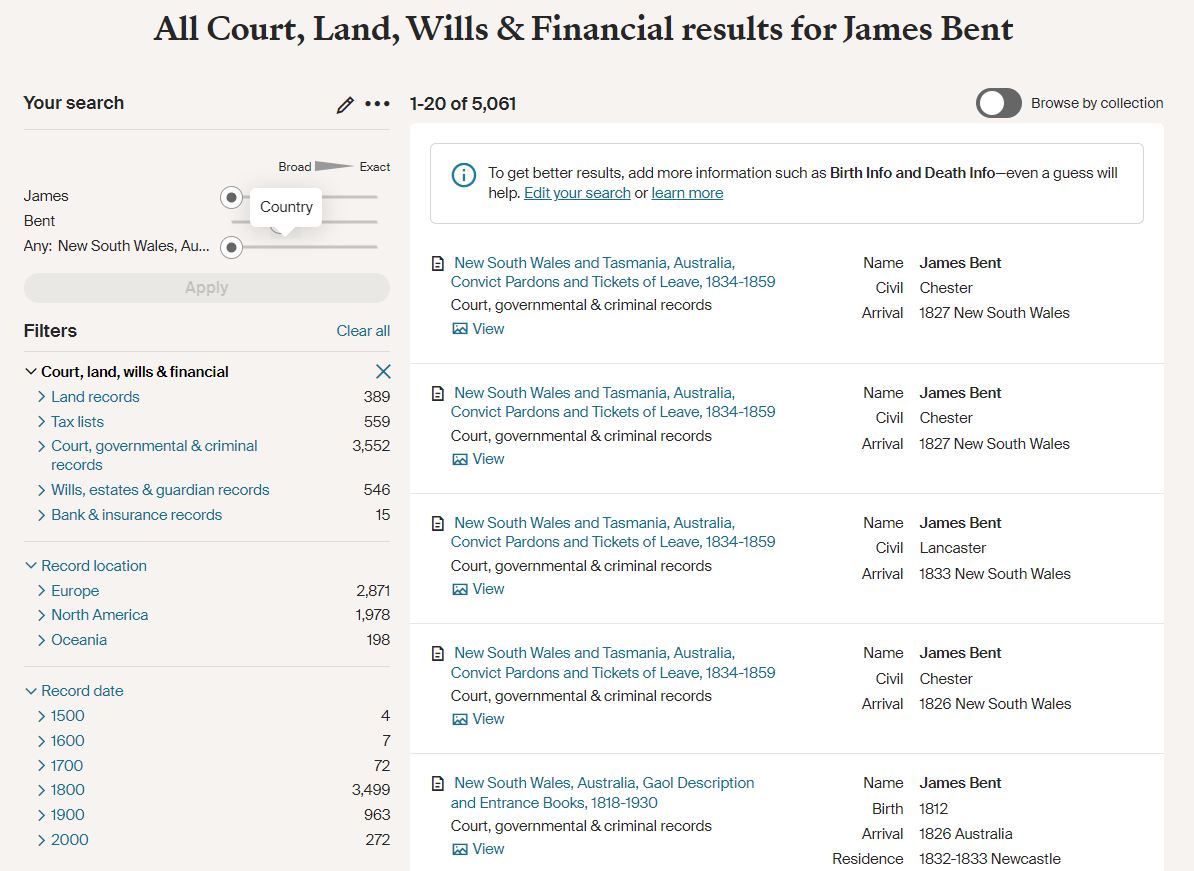
The search has returned 127,307 results. The top results look promising, and we could view these results immediately, but let us filter the results a little. In the right hand column, select 'Court, land, wills & financial'.
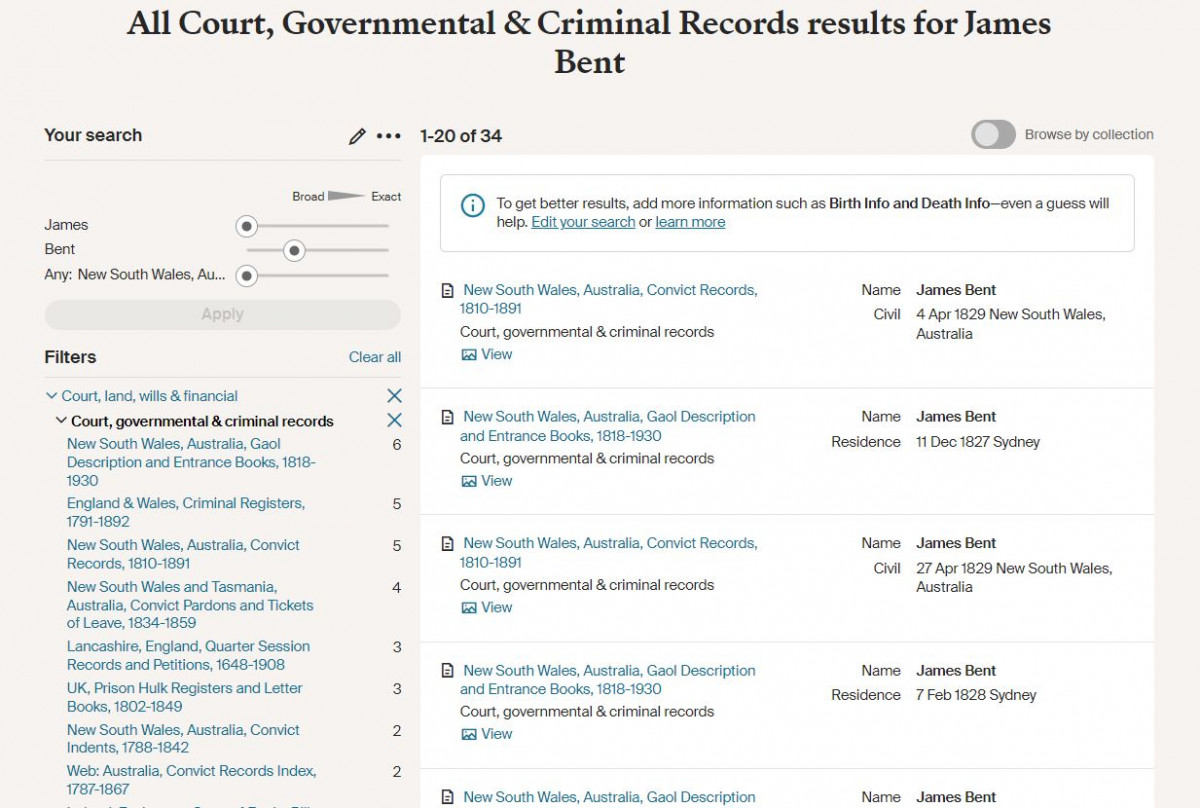
We now have a list returning 5,061 results. Again, the top results all look promising, but we are going to apply another filter before viewing anything. We can narrow down by 'Record Date' (1800s, and specifically 1820s in this instance), and by record type (Court, government & criminal records).
This list is looking more manageable at 34 results. Let's start opening some records and see if this is the same James Bent who ended up at Limestone Station. We will commence with the record that tops the list: New South Wales, Australia, Convict Records, 1810-1891.
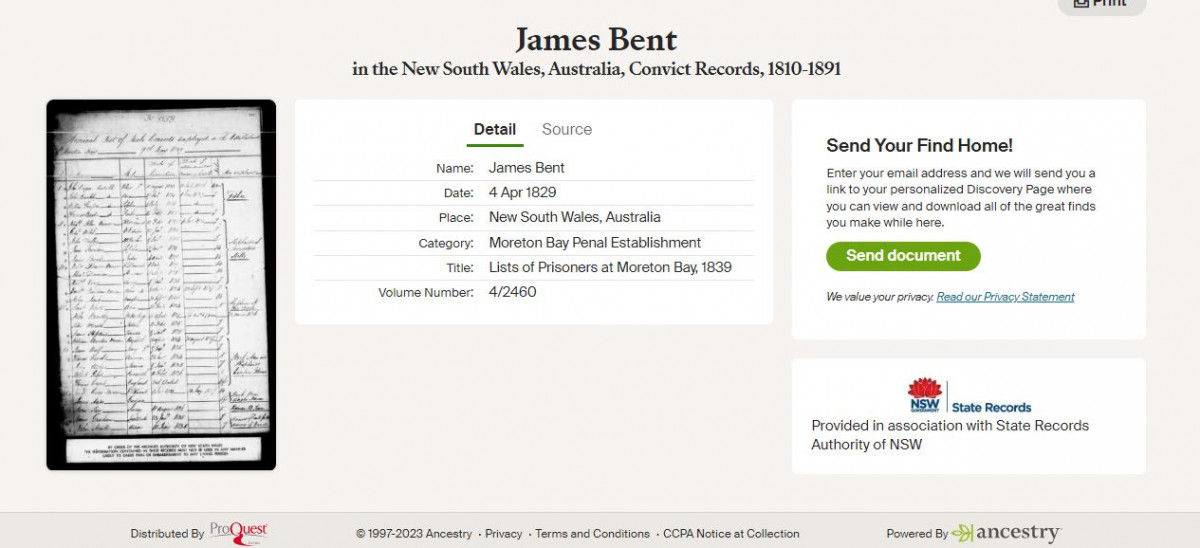
Okay, we have definitely got our man. This record, dated 1839, reveals that Bent was a prisoner at Moreton Bay.
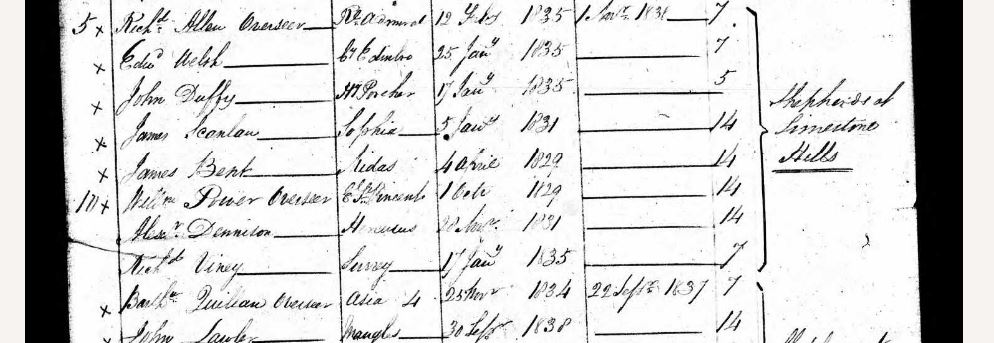
As a bonus, when we view the record, we can see that James arrived on the Midas, was convicted on 4th April 1829, is serving 14 years and he was assigned work as a shepherd at Limestone Hills on the 1st January 1838. We even have the name of fellow shepherds assigned alongside Bent, including the name of their convict overseers, Richard Allan and William Power. (Also, below this list is the list of convicts assigned to be shepherds at the Redbank station).
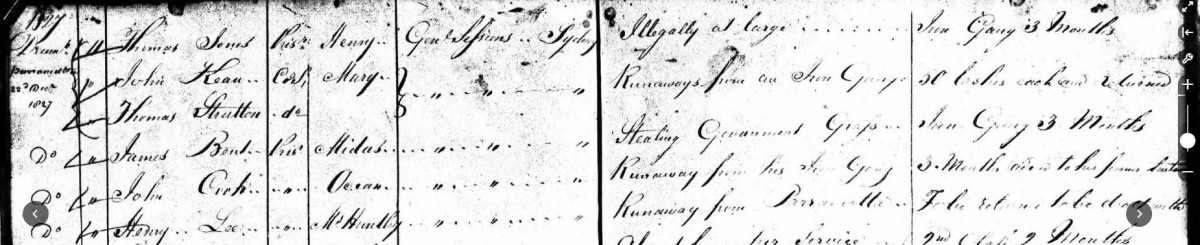
The second record for James Bent provides us with a date discrepancy. The New South Wales, Australia, Gaol Description and Entrance Books, 1818-1930, list his date of admission as 11th December 1827, and not 4th April 1829, as the previous document suggested. We know we are still following the correct James Bent, as the Midas is listed as the hsip he was transported on. This gives us two options: either someone has written the date down wrong, or Bent might have faced a second conviction in 1829. We better keep digging.
In this record, we learn that James was convicted of stealing government ... [don't worry, there will be plenty more documents to figure out what the missing word might be, because whilst it looks like 'grapes' at first glance, somehow I do not think that is what he stole].
Trove
Let's now do a simple Trove search to see if there is any record of Jame's foray into bushranging.
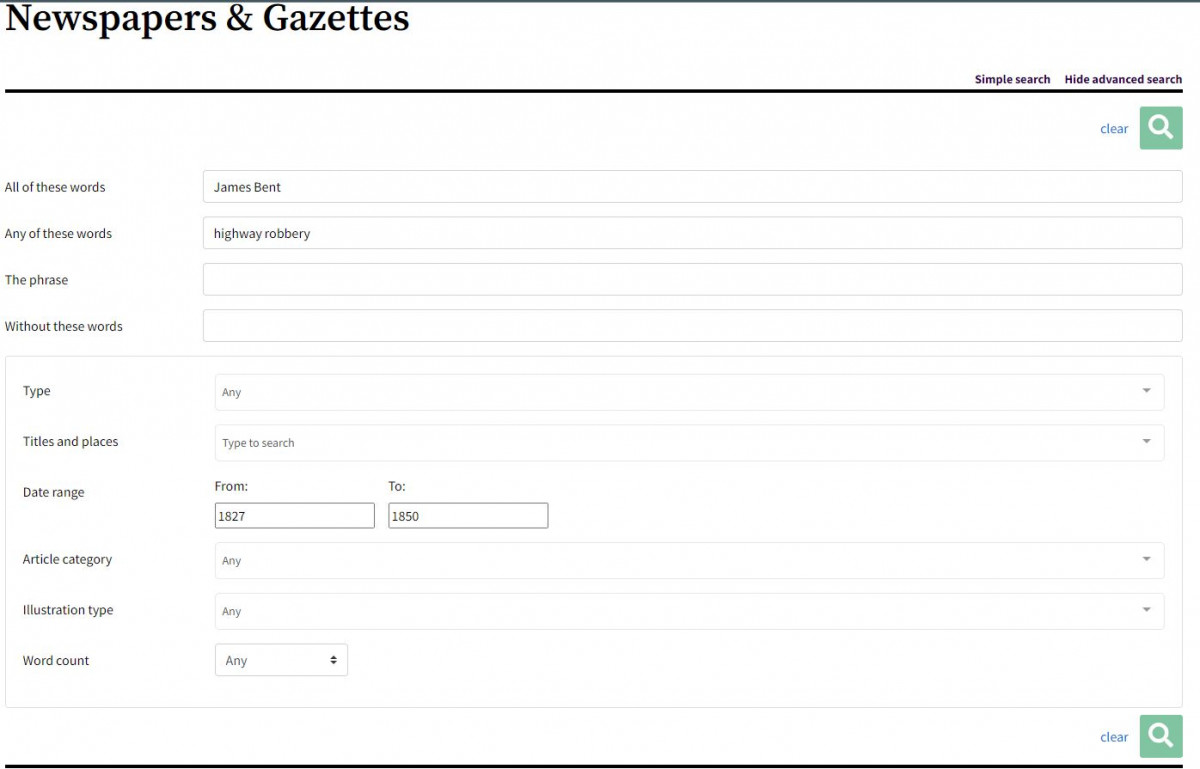
Under the search bar, select 'Advanced Search'. In the dropdown menu, select 'Newspapers & Gazettes':

In the 'All of these words' field, entre 'James Bent'. For the date range we will use 1827 (the year he arrived in New South Wales) and 1850 (two years after he received a Ticket of Leave). To narrow the search further, in the field 'Any of these words', we have added 'highway robbery'.
The top three results seem to be our James Bent.
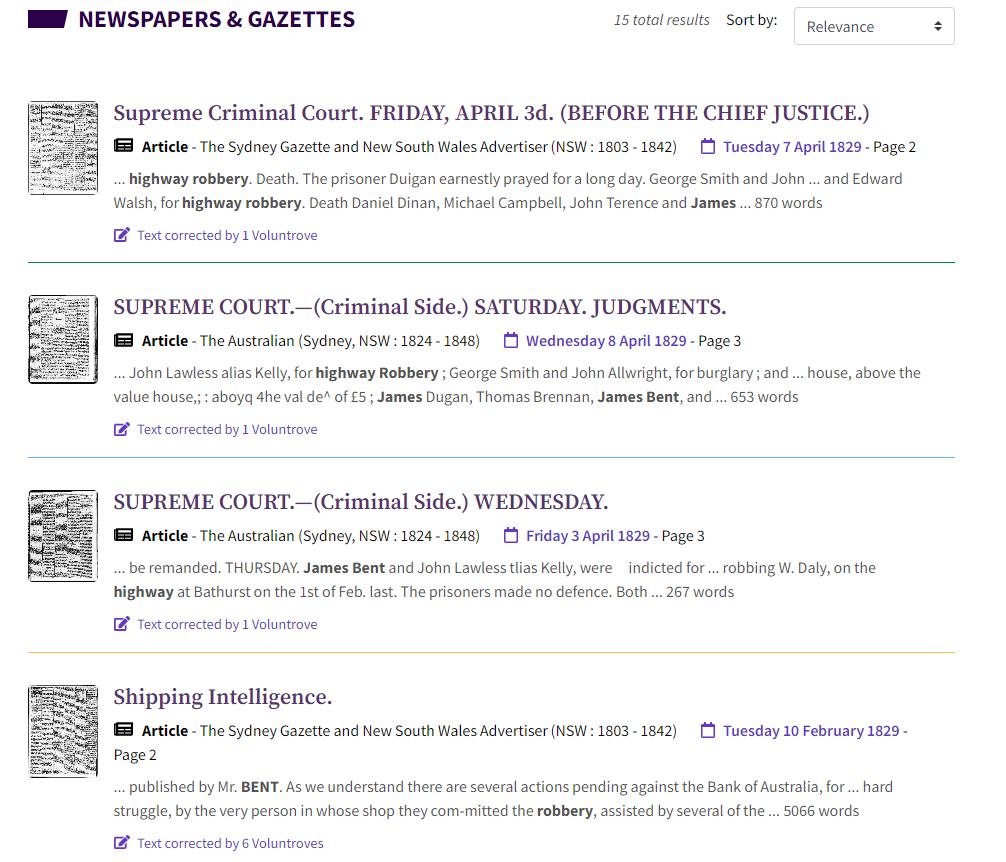
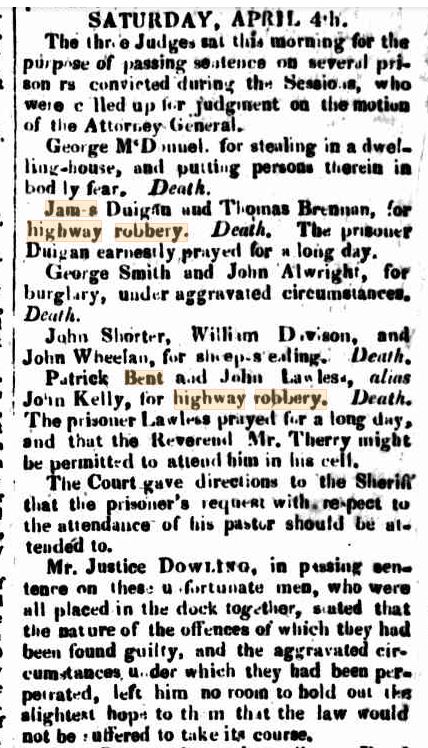
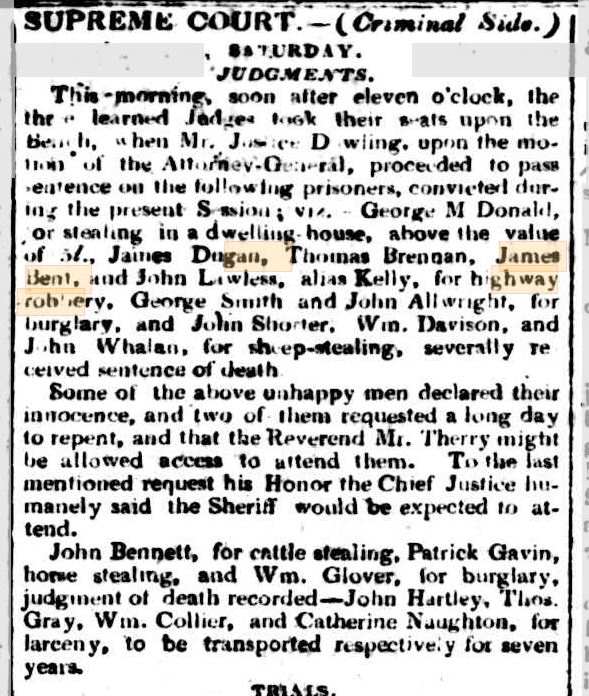
The first article, which appeared in The Sydney Gazette and New South Wales Advertiser, on Tuesday 7th April 1829, p.2, reports that on Saturday 4th April the Judge passed sentence on several prisoners who were convicted during an earlier held Session, and who were called up for judgment on the motion of hte Attorney General. They list a 'Patrick' Bent as accomplice to John Lawless (alias John Kelly) as having been convicted for highway robbery and being sentenced to death.
The dates and accomplice match our earlier information. Bent's first name, though, means we either have the wrong person, or the wrong name has been recorded. Time to check the next article.
The Australian, from Wednesday 8th April 1829, p.3, lists the judgments passed down by the Supreme Court and this time Bent's first name is recorded as 'James'.
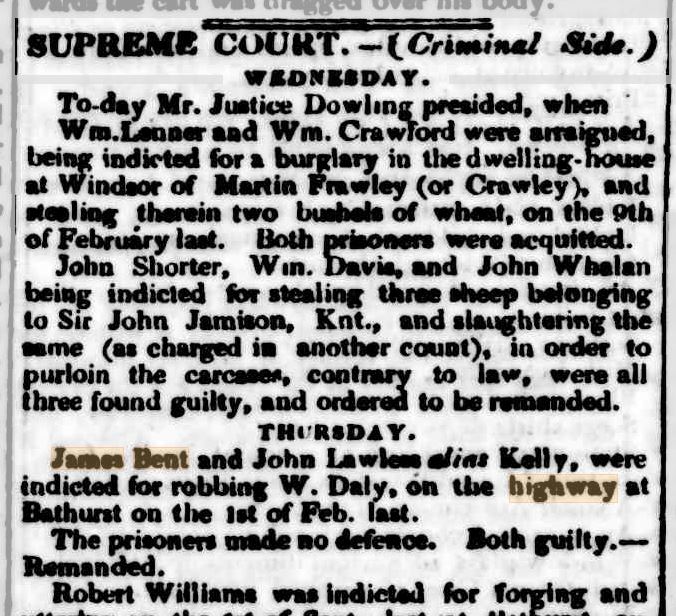
The Australian, from 3rd April 1829, p. 3, provides us with a little detail of the offense: that, on the 1st February 1829, James Bent and John Lawless (alias Kelly) robbed W. Daly on the highway near Bathurst. Neither men made a defence and both were found guilty.
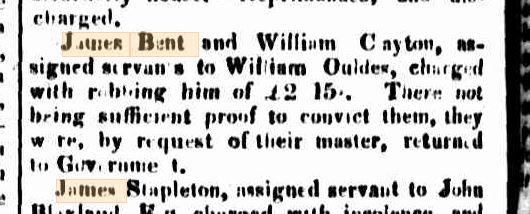
Troving through the newspaper records we find further reference to James Bent. A police report in The Sydney Gazette and New South Wales Advertiser, from Thursday 12th April 1827, p.2, lists James Bent, along with William Cayton, both assigned servants of William Oulders, as being charged with the theft of £2 15/. Due to a lack of evidence, both men were, at the request of Oulders, returned to the Government.
The British Newspaper Archive
Unlike Trove, The British Newspaper Archive is not a free-to-access service. You can sign up to access 3 free page views before you would have to start paying a monthly subscription. Because of this, we will not demonstrate here how to access the archive, instead, we will show you the results of one of our free searchers.
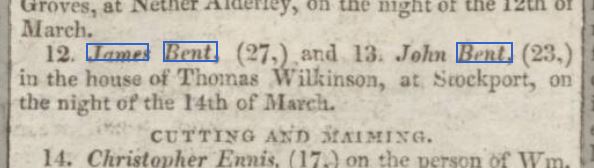
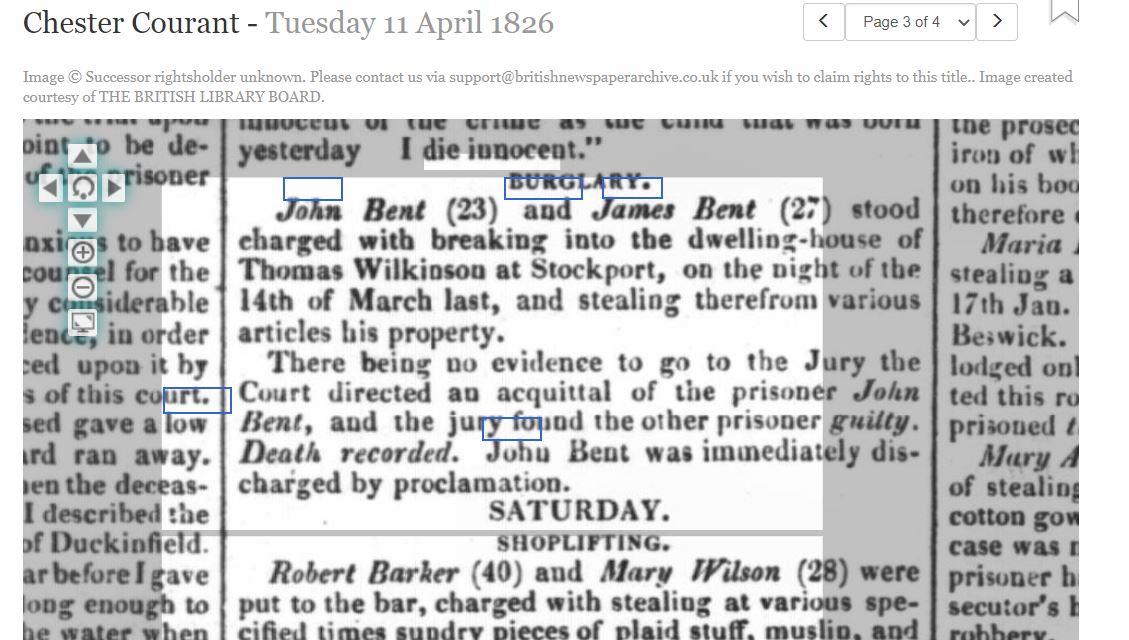
Appearing in the Chester Courant on Tuesday 11th April, 1826, is a reference to the court proceedings for James Bent. He was aged 27 and was co-accused with John Bent, aged 23, likely to be his brother. The charge was burglary, with both men accused of breaking into the house of Thomas Wilkinson at Stockport on the 14th March 1826. John Bent was acquitted due to lack of evidence. James was found guilty by the jury and was sentenced to death. It was not recorded here what properity was taken or its value.
The Chester Chronicle, from Friday 31st March 1826, includes James and John Bent in the list of 59 prisoners who were to appear in the Chester Court of Assizes the following Monday.