


In September 1870, Charles Smith bought the “Woodlands” selection of land at Marburg which consisted of 568 acres. As local timber resources became depleted in the 1880s, his son Thomas Lorimer Smith decided to plant sugar cane on the property and subsequently constructed a sugar mill around 1883. At this time Marburg was a small town that had a large German settlement with many of these families establishing dairy and pig farms. As well as vegetable and grain crops, sugar cane and coal were also widely produced and mined in this area. The Marburg Sugar Mill was established and became one of the largest Sugar Mills in south east Queensland. In 1905 the Mill was sold to the Gibson family who were experienced sugar farmers and mill owners operating Bingera Plantation near Bundaberg. The mill closed in 1918 and was dismantled and re-built at Bingera soon after World War 1.
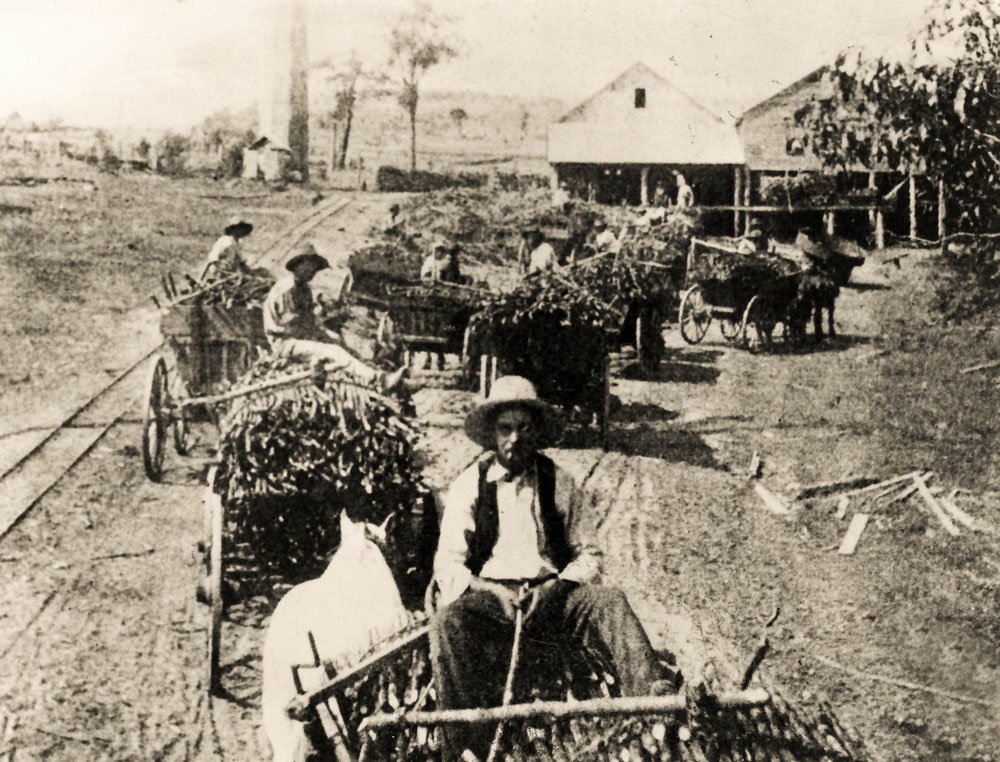
Carting cane to the Marburg Sugar Mill, Marburg 1916 – Image Courtesy of Picture Ipswich
Information taken from: German Settlement in the Rosewood Scrub by Frank Snars, Ipswich in the 20th century by R. Buchanan and Woodlands of Marburg – By the Bremer Blog, ‘A Day in Rosewood Scrub‘, The Queenslander, 14 July 1883, pp. 39-40, ‘Local and General News’, Queensland Times, 16 August 1883, p.3.