


The following information is for the interest of residents of the Ipswich area. Many readers of our blog are also interested in discovering more about where they can view fossils or in some cases fossick. There are a number of conservation areas in Ipswich where evidence of bug and plants fossils can be seen including the Denmark Hill Conservation Park which can be accessed via Quarry Street, Ipswich. Here you can view what is called the ‘Triassic Park’ which has examples of fossils discovered in the area in the early 1890s. Another area where examples of plant fossils and petrified wood can be seen is at the Haig Street Quarry Bushland Reserve, located at High Street, Brassall. These two areas are open to the public, however you are not permitted to fossick in these areas as they are conservation parks. There are also a number of other fossil sites in the local area which are closed to the public including:
Redbank Plains
Fossils and ancient rock formations located along bushland on Jones Road and Brittains Road
Mt Crosby
Fossils and ancient rock formations located along the old Mt Crosby Railway Line adjacent to Mt Crosby Road at Colleges Crossing
Moffatt Street, south of Denmark Hill, Ipswich
Fossils and ancient rock formations located in the section of Moffatt Street between Pound and Macalister Street.
Limestone Hill, Ipswich
Located in Queens Park this area has a range of basalt and limestone formations. Gastropod fossils can also be found in this area. You are not permitted to fossick in this area as it is a conservation park.
In the event that you wish to fossick in any location that is not a conservation/national park or land with a native title agreement, there are a number of rules and regulations that you must adhere to ensure the integrity of the natural environment. It is advisable that you also obtain a fossicking license, however even with this license you will still need to obtain written permission from the land owner if the site is located on a privately owned block. If permission from the land owner is granted and a license is obtained you as a fossicker are still only permitted to remove fossils of items that do not have backbone (e.g. plant and bug fossils). Failing to follow the above could result in an on-the-spot fine, infringement notice or a loss of your fossicking licence. So, before going out on your next fossil expedition please keep this in mind and make sure that you contact the Department of Natural Resources and Mines on 3199 7774 if in doubt.
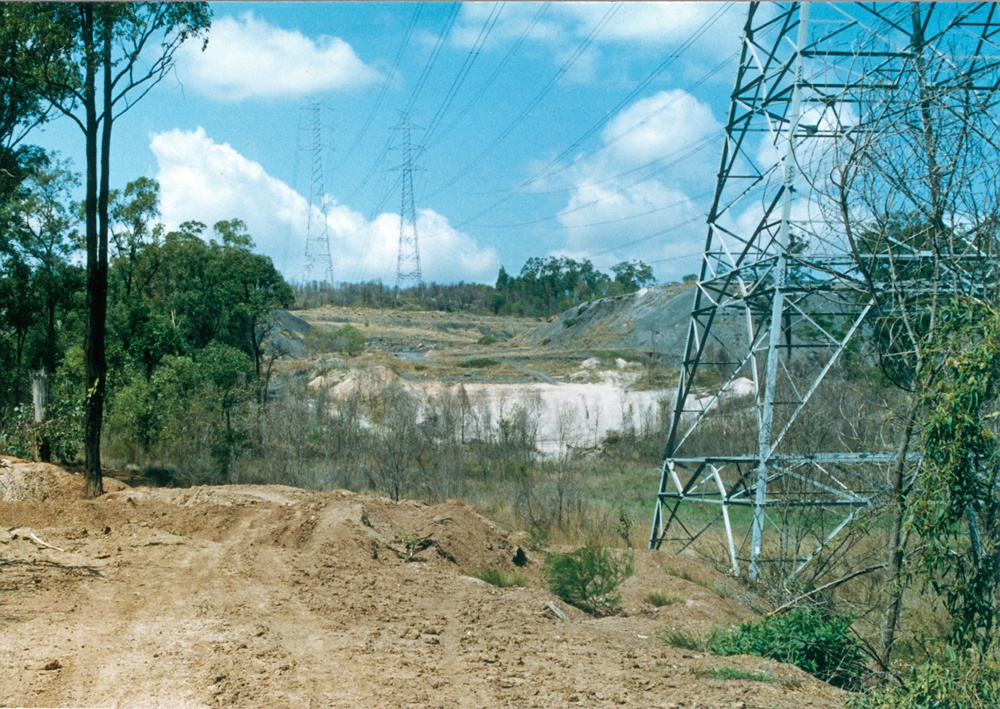
Triassic Fossil locality, 41 Cairns Road, Ebbw Vale, Ipswich, 1991 – Image courtesy of Picture Ipswich
Fossil sites in the area of Ipswich have been well known by locals for many years. There are several Triassic fossil sites in the surrounding suburbs of Ipswich including sites at Redbank Plains, Dinmore, Ebbw Vale and Mount Crosby. The fossil site of Redbank Plains is an area located on Jones and Brittains Road, that is fast being developed into housing for the growing population of Ipswich. However, there are still said to be examples in the area that show fossils of fish, crocodiles, turtles, birds, insects and plants contained in rocky outcrops of shale and ironstone. Previous specimens uncovered in this area were said to have been found in small holes on surrounding slopes, however, much of these areas now have been developed.
The area of Dinmore also contains a fossil site specifically within the local Dinmore Quarry, which is said to be home to several late Triassic flora. The site was once home to several breeds of Dicroidium flora (ferns), bryophytes (moss) and gymnosperm (conifers, cycads) which have now formed fossils within the Blackstone shale that is present at the site. The site is also said to contain fossils of insects and other invertebrates, which have been preserved in Lacustrine (lake) sediments present in this area.
Mount Crosby also has a large fossil reserve located on the old Mount Crosby Railway line adjacent to Mount Crosby Road near College’s Crossing. The site is said to contain insect fossils, which are relatively rare but abundant in this area. The fossils present at the Mount Crosby site mainly contain parts of insects such as wings, which are preserved in shale deposits and situated in a pipeline easement.
All of these sites will eventually be under threat from future developments in the local and surrounding areas, as the population of Ipswich increases. Therefore it is important to preserve these sites, their heritage and the value that they bring to the areas in which they reside.
**ADDENDUM (added 21/07/2015)